42 Weeks Pregnant
At 42 weeks pregnant you are postterm — your baby is fully grown and ready, around 20.5 inches and 7.5 to 8 pounds, but the small risks of waiting now rise, so most US providers recommend induction by 42 weeks 6 days at the latest. Intensive monitoring continues with twice-weekly tests, and if you are reading this you are likely already in active conversation with your provider about an induction date. Decreased movement is the single most urgent sign to take seriously.
Your week at a glance
| This week | Details |
|---|---|
| Baby size | Roughly 20.5 inches and 7.5–8 pounds; healthy babies vary a lot |
| What is developing | Fully grown. Some babies show postmaturity signs; amniotic fluid can decrease |
| Your symptoms | Relentless pelvic pressure, broken sleep, heartburn, deep exhaustion |
| To-do | Finalize induction logistics, continue monitoring, track movement, hospital bag by the door |
How big is your baby at 42 weeks?
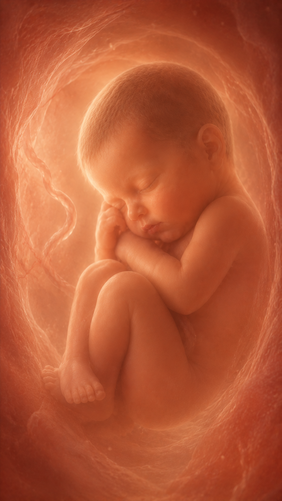
ACOG defines postterm as 42 weeks 0 days and beyond. Your baby is around 20.5 inches long and roughly 7.5 to 8 pounds, although healthy babies at this stage vary a lot in size. They are fully grown in every important way — lungs ready to breathe air, digestive system ready to handle milk, immune system loaded with antibodies from you, brain at the milestones needed for life on the outside. Most US providers do not allow pregnancy to continue past 42 weeks 0 days, because the small risks of waiting at this point — including, rarely, stillbirth — start to rise more sharply. If you are reading this, you are likely already in active conversation with your provider about an induction date, or one has already been scheduled.
A small portion of babies born postterm show what is called postmaturity syndrome: dry, peeling, slightly wrinkled "parchment-like" skin, less fat under the skin (since the placenta has been less efficient at delivering nutrients), long fingernails, and meconium-stained amniotic fluid (which can mean your baby passed their first stool before birth, sometimes inhaling it). These babies almost always do very well after birth, but they may need extra observation in the first hours. Most babies born at 42 weeks look completely typical — these signs are not universal. The amniotic fluid can also decrease at this stage, which is one of the reasons your provider monitors so closely. Movement is still your most important signal: most babies are head-down with the chin tucked, and movements may feel like firm rolls and shoves rather than sharp kicks because space is tight.
42 weeks pregnant symptoms
Physically, this is one of the hardest stretches of pregnancy. These are the common things you may notice this week:
- Relentless pelvic pressure, aching hips and pubic bone, and a lower back that complains all day
- Broken sleep at best and heartburn that does not quit
- Mild leg and ankle swelling, which is normal — but sudden swelling in your face or hands, or one leg much more than the other, needs a same-day call
- Intense, frequent Braxton Hicks, with discharge that may increase and more pieces of the mucus plug coming away
- Big emotions — overwhelmed, scared, frustrated, or strangely numb, all of which are real and valid
Knowing the difference between true labor and Braxton Hicks really matters now. True labor contractions get longer, stronger, and closer together over time, and do not ease with rest, water, or position changes. Practice contractions stay irregular and let up when you change position, drink water, and rest. Pregnancy at 42 weeks raises the risk of higher-degree tearing, postpartum bleeding, infection, and cesarean delivery, which is why your provider will be following you closely. If anxiety, panic, or hopeless feelings get heavy, tell your provider — crisis lines are available 24/7 (988 for the Suicide and Crisis Lifeline).
Taking care of yourself this week
Rest and hydration are non-negotiable this week. Side-lying breaks during the day, ideally on the left, help take pressure off the big veins in your belly and support blood flow to your baby. Even 20 to 30 minutes can ease swelling and bring real relief. A few short gentle walks each day help with pelvic mobility, digestion, and sleep, and may encourage your baby to settle deeper. Time on a birth ball with slow hip circles, side-lying stretches, pelvic tilts, and gentle cat-cow all help. Skip any new or strenuous activity. Warm showers, deep breathing, and quiet rituals like reading or music help take the edge off the waiting.
- Eat light, small, and frequent — three big meals are too much for the limited stomach space you have.
- Keep water steady — hydration helps with practice contractions, swelling, and energy.
- Finalize induction logistics — confirm the date, time, and location, what to bring, what to eat (or not) before you arrive, and what time to call ahead.
- Arrange pet care, older sibling care, and other logistics for an absence that could last a few days.
- Skip herbal labor-induction remedies — castor oil, blue and black cohosh, and evening primrose oil can cause unsafe contractions; at 42 weeks the safer route is a planned medical induction.
Standard pregnancy food safety still matters: skip unpasteurized dairy, raw sprouts, high-mercury fish, deli meats unless steaming hot, and undercooked meat or eggs. Skip alcohol. Keep the hospital bag by the door, the car seat installed and double-checked, and your keys, phone, charger, ID, and insurance card in one place.
Appointments & tests
At 42 weeks, intensive antenatal monitoring continues — typically twice-weekly nonstress tests and ultrasound checks of amniotic fluid (often called a modified biophysical profile). A nonstress test (NST) involves two soft monitors on your belly for about 20 to 40 minutes, watching your baby's heart rate respond to movement. The fluid measurement looks at the deepest vertical pocket around your baby, or sometimes the amniotic fluid index. Together these give your provider a clear picture of whether your baby is still doing well. If anything is not reassuring, your provider will recommend prompt delivery — usually induction, sometimes cesarean depending on the situation.
Most US providers recommend that delivery happen by 42 weeks 6 days at the latest. ACOG supports induction at 41 to 42 weeks because the risks of continuing pregnancy — including stillbirth, meconium aspiration, decreased amniotic fluid, and complications during birth — rise after 41 weeks. If induction has not already begun, it will likely start this week. Common methods include cervical ripening medications (often a prostaglandin like misoprostol or dinoprostone), membrane sweeping, a Foley balloon to mechanically open the cervix, breaking the water (amniotomy), and IV Pitocin to stimulate contractions. These are often used in combination, and the process can take a day or two for a first labor. Ask about realistic timelines, what you can eat or drink, whether you can walk around or use a birth ball, and when an epidural is available. Bring your hospital bag, insurance card and ID, a printed copy of your birth preferences, snacks for your support person, and a phone charger with a long cord.
Call your provider if
- Your baby's movements feel clearly fewer, weaker, or different — lie on your left side, drink something cold, count movements, and call right away if you do not feel 10 in an hour
- Your water breaks or you notice any leaking fluid — go straight to labor and delivery if it is green, brown, or stained
- Contractions come every 5 minutes, each lasting about a minute, for at least an hour (the 5-1-1 rule), or sooner if you have had a baby before
- Any bleeding heavier than spotting or bloody show
- Severe or persistent headache, vision changes, sudden swelling in your face or hands, pain in your upper right abdomen, chest pain, or a sudden rapid heartbeat (call 911 for chest pain or a seizure)
Reflects Mayo Clinic and Cleveland Clinic third-trimester fetal-development references and fetal-movement (kick count) guidance, 2024–2026.
Related questions
- What does 42 weeks pregnant (postterm) mean?
- ACOG defines postterm as 42 weeks 0 days and beyond. Your baby is fully grown — lungs ready to breathe, digestive system ready for milk, immune system loaded with antibodies. Most US providers do not allow pregnancy to continue past 42 weeks 0 days because the small risks of waiting, including, rarely, stillbirth, start to rise more sharply.
- Is it safe to be 42 weeks pregnant?
- Past 41 weeks the risks of continuing — including stillbirth, meconium aspiration, decreased amniotic fluid, and complications during birth — rise, which is why most US providers recommend delivery by 42 weeks 6 days at the latest. Intensive monitoring (twice-weekly nonstress tests and fluid checks) continues, and if anything is not reassuring your provider will recommend prompt delivery.
- What is postmaturity syndrome?
- A small portion of babies born postterm show dry, peeling, slightly wrinkled "parchment-like" skin, less fat under the skin, long fingernails, and meconium-stained amniotic fluid. These babies almost always do very well after birth but may need extra observation in the first hours. Most babies born at 42 weeks look completely typical — these signs are not universal.
- How does induction work at 42 weeks?
- Common methods include cervical ripening medications (a prostaglandin like misoprostol or dinoprostone), membrane sweeping, a Foley balloon to mechanically open the cervix, breaking the water (amniotomy), and IV Pitocin to stimulate contractions. These are often used in combination, and the process can take a day or two for a first labor. Ask about realistic timelines, eating and drinking, walking around, and pain relief.
Sources & further reading
ParentFlow: one free app, pregnancy to age six
ParentFlow follows your pregnancy week by week — baby size, what's developing, your symptoms, and the appointments and warning signs that matter — then becomes a free baby tracker for feeds, sleep, and growth after birth. Free on iPhone and Android.
App Store Google Play Open Web AppThis article reflects current ACOG, Mayo Clinic, Cleveland Clinic, CDC, and FDA guidance and is for educational purposes only. It does not constitute medical advice. ParentFlow is a wellness companion — not a substitute for your obstetric provider. For any medical concern, contact your healthcare provider.