10 Weeks Pregnant
At 10 weeks pregnant your baby is about the size of a strawberry — roughly 31 to 42 mm — and is now officially called a fetus. Tiny elbows can bend, fingers and toes are separating, and the kidneys are starting to make a small amount of urine. Your uterus is about the size of a large orange, and nausea may be peaking or finally starting to ease.
Your week at a glance
| This week | Details |
|---|---|
| Baby size | About a strawberry, roughly 31–42 mm crown to rump, a few grams |
| What is developing | Rounder head, bending elbows, separating fingers and toes, first nails, working kidneys |
| Your symptoms | Peaking or easing nausea, fatigue, frequent peeing, sore breasts, ligament twinges, mood swings |
| To-do | Aim for about 30 minutes of gentle movement most days, wash produce well, set up a prenatal folder |
How big is your baby at 10 weeks?
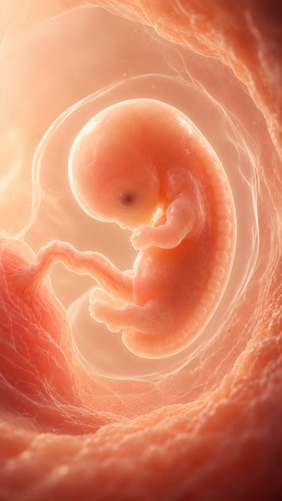
Your baby just hit a big milestone — they are now officially called a fetus instead of an embryo, and they are about the size of a strawberry, roughly 31 to 42 millimeters from crown to rump and weighing only a few grams. The head is starting to look rounder and a little more human, even though it is still very large compared to the body. Tiny elbows can bend now, the webbing between fingers and toes is disappearing, and the very beginnings of nails are starting to form. Inside, the heart has all four chambers working together and beats almost twice as fast as yours, and the kidneys are quietly starting to make a small amount of urine.
You will not feel any of this yet — your baby is still far too small for movement to reach you — but an enormous amount is happening behind the scenes. Brain growth is racing forward this week, with new brain cells forming at a remarkable pace and starting to connect, and basic facial features like the upper lip and a more defined nose are showing up on ultrasound. At a prenatal visit around now, your provider may try to find the heartbeat with a handheld Doppler; it does not always pick up this early because the baby is still tucked low and tiny, so try not to worry if you do not hear it on the very first attempt.
10 weeks pregnant symptoms
Your uterus is now roughly the size of a large orange or a small grapefruit and is just starting to rise up out of your pelvis. Pregnancy hormones are at peak levels right around now, which is one reason this stretch of the first trimester often feels like the hardest part. These are the common, normal symptoms this week:
- Nausea and food aversions that often crest somewhere between weeks 8 and 10, then start to ease as you approach week 12
- Deep fatigue — growing a placenta is genuinely hard work, not just in your head
- Frequent urination as your uterus presses on your bladder
- Sore or fuller breasts with darker areolas
- Mild round-ligament twinges in your lower belly when you shift positions
- Mood swings, mild headaches, and more vivid dreams
- Increased vaginal discharge that is thin and milky
None of these are signs that something is wrong; they are standard first-trimester territory and usually settle as you head into the second trimester. Some people — particularly those who have been pregnant before — may also notice a small lower-belly swell or that their usual jeans feel a little snug, even though a real bump is still weeks away.
Taking care of yourself this week
If you are feeling up to it, gentle daily movement is one of the kindest things you can do for yourself right now. The CDC and ACOG both recommend about 150 minutes of moderate-intensity activity each week during a healthy pregnancy — think 30 minutes of brisk walking, prenatal yoga, swimming, or low-impact stationary cycling, spread across most days. An easy gauge is the "talk test": if you can hold a conversation but could not comfortably sing while moving, you are at about the right intensity. On the days when nausea or exhaustion win, rest absolutely counts as self-care too.
- Focus on what is on the plate, not how much — you do not need extra calories in the first trimester. Aim for whole grains, lean proteins, dairy or fortified alternatives, plenty of vegetables and fruit, and a daily prenatal vitamin with folic acid, iron, iodine, and DHA.
- Steer clear of a few foods — high-mercury fish (swordfish, king mackerel), unpasteurized soft cheeses and milk, raw or undercooked meat and eggs, raw sprouts, and deli meats unless heated until steaming hot.
- Wash all produce thoroughly under running water — this protects against Listeria and Toxoplasma.
- Check before starting something new if you have any bleeding or cramping or a high-risk pregnancy.
One small step that saves stress later is to set up a simple pregnancy folder — physical or a single note on your phone. Use it for lab results, ultrasound photos, your provider's after-hours number, insurance details, your hospital or birth-center info, your blood type, allergies, your prenatal vitamin name, your last period date, and a running list of questions. Having it all in one place makes urgent moments calmer and every visit more efficient.
Appointments: first-trimester screening
Sometime between weeks 10 and 13, your provider will likely offer first-trimester screening. It has two pieces that fit together: a blood test that measures free beta-hCG and PAPP-A, and a special ultrasound called a nuchal translucency, or NT, scan that measures a small clear space at the back of your baby's neck. Together they give a personalized estimate of the chance your baby has Down syndrome (Trisomy 21) or Trisomy 18. It is important to know up front that this is a screening, not a diagnosis — a higher-risk result simply means more information might be helpful, not that anything is wrong.
The NT ultrasound is usually done on a higher-resolution scanner, often by a sonographer or maternal-fetal medicine specialist. You lie back, warm gel goes on your belly (sometimes a vaginal probe is used if the baby is hard to see), and the scan typically takes 20 to 40 minutes; the blood draw is quick. Many parents also choose Non-Invasive Prenatal Testing (NIPT), a blood-only screening that can be drawn from about week 10 onward. Ask your provider which combination is right for you and which tests your insurance covers, and bring a partner if you can — seeing your baby on ultrasound for the first time can be both joyful and unexpectedly emotional.
Call your provider if
- Bright red bleeding heavier than spotting, especially soaking through a pad, or cramping noticeably worse than period pain
- One-sided pelvic pain — even mild — especially with shoulder pain or dizziness (possible ectopic pregnancy; this should be checked promptly)
- A sudden gush or leaking of fluid from the vagina
- Fever above 100.4°F, burning with urination, or strong-smelling discharge
- Persistent vomiting where you cannot keep fluids down for 24 hours, or a sudden disappearance of pregnancy symptoms that worries you
Reflects Mayo Clinic and Cleveland Clinic first-trimester fetal-development references, ACOG nausea-of-pregnancy guidance, and MedlinePlus pregnancy resources, 2024–2026.
Related questions
- How big is the baby at 10 weeks pregnant?
- About the size of a strawberry — roughly 31 to 42 millimeters from crown to rump and weighing only a few grams. The head is rounder, tiny elbows can bend, the webbing between fingers and toes is disappearing, and the kidneys are starting to make a small amount of urine.
- When is the nuchal translucency (NT) scan done?
- First-trimester screening is usually scheduled somewhere between weeks 10 and 13. It pairs a blood test (free beta-hCG and PAPP-A) with a special ultrasound that measures a small clear space at the back of the baby's neck, giving a individual risk estimate for Down syndrome and Trisomy 18. It is a screening, not a diagnosis.
- Can the heartbeat be heard with a Doppler at 10 weeks?
- Sometimes. At a prenatal visit around now your provider may try a handheld Doppler, but it does not always pick up the heartbeat this early because the baby is still tucked low and tiny. Not hearing it on the first attempt is common and usually nothing to worry about — most providers simply try again in a couple of weeks.
- Is it normal for nausea to still be this bad at 10 weeks?
- Yes. Pregnancy hormones are at peak levels right around now, and many people find nausea and food aversions crest somewhere between weeks 8 and 10 before starting to ease as they approach week 12. Call your provider if you cannot keep fluids down for 24 hours, which can signal hyperemesis.
Sources & further reading
ParentFlow: one free app, pregnancy to age six
ParentFlow follows your pregnancy week by week — baby size, what's developing, your symptoms, and the appointments and warning signs that matter — then becomes a free baby tracker for feeds, sleep, and growth after birth. Free on iPhone and Android.
App Store Google Play Open Web AppThis article reflects current ACOG, Mayo Clinic, Cleveland Clinic, CDC, and FDA guidance and is for educational purposes only. It does not constitute medical advice. ParentFlow is a wellness companion — not a substitute for your obstetric provider. For any medical concern, contact your healthcare provider.