12 Weeks Pregnant
At 12 weeks pregnant, you're nearing the end of the first trimester, the fetus is about the size of a plum, and many people find nausea and fatigue start to ease. This is also the screening window: the nuchal translucency scan (11-13 weeks) and cell-free DNA (NIPT) results often land now, and miscarriage risk drops markedly once a healthy 12-week scan is confirmed.
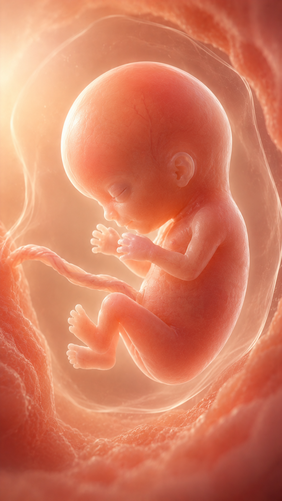
Lime-sized this week — fingernails are forming, intestines have tucked into the belly, and reflexes are starting to fire.
5.4 cm length · ~14 g weight
This week at a glance
| Item | Where things stand at 12 weeks |
|---|---|
| Baby's size | About a plum (~2.5-3 inches) |
| What's developing | Organs, limbs, bones, and muscles all present; digestive and urinary systems working |
| Your symptoms | Nausea and fatigue often easing; less frequent urination as the uterus rises |
| Screening window | NT scan at 11-13 weeks; NIPT (cell-free DNA) available from 10 weeks |
| Milestone | End of the first trimester is near; miscarriage risk drops after a healthy scan |
Baby development at 12 weeks
At 12 weeks the fetus is roughly 2.5 to 3 inches long, about the size of a plum. All the organs, limbs, bones, and muscles are now present and will keep maturing for the rest of pregnancy rather than forming from scratch.
The circulatory, digestive, and urinary systems are working, and the liver is producing bile. The face looks more clearly human, fingers and toes are separated, and tiny nails are starting. Reflexes are developing, the fetus can move, though you won't feel it yet.
Symptoms easing as the trimester ends
Many people turn a corner around now. As hCG levels off, nausea and the heaviest fatigue often start to lift, and some of that first-trimester energy returns over the next few weeks.
As the uterus rises out of the pelvis, the constant urge to pee may ease too. You might notice new things, such as a darkening line down the belly (linea nigra), mild round-ligament twinges, or clearer skin for some and breakouts for others. If nausea is still strong, that's also within normal range.
First-trimester screening: NT and NIPT
Two optional, non-invasive screens cluster around now. The nuchal translucency (NT) scan is an ultrasound done between 11 and 13 weeks (when the fetus measures 45-84 mm crown to rump) that measures fluid at the back of the neck to estimate the chance of certain chromosomal conditions. It's often paired with a blood test.
Cell-free DNA screening, also called NIPT, is a maternal blood test available from 10 weeks that screens for conditions such as Down syndrome with high accuracy. Both are screening tests, they estimate risk rather than diagnose. Your provider can explain results and, if needed, discuss diagnostic options like CVS or amniocentesis.
Miscarriage risk drops through the first trimester
| Point in pregnancy | Approximate miscarriage risk |
|---|---|
| Across the known first trimester | About 10-15% |
| After a normal scan with heartbeat at 12-14 weeks (low-risk) | Roughly 0.5-2% |
| After the first trimester | Low; most losses occur before this point |
Call your doctor if
- Heavy vaginal bleeding (soaking a pad in an hour) or passing clots or tissue
- Severe or persistent abdominal or pelvic pain or cramping
- Fever over 100.4 F (38 C) or chills
- Severe vomiting that prevents keeping fluids down, or signs of dehydration
- Sudden, dramatic loss of pregnancy symptoms with bleeding
Reflects Cleveland Clinic fetal-development and NT-scan guidance plus ACOG chromosomal-screening guidance, 2024-2026.
Related questions
- Does miscarriage risk really drop at 12 weeks?
- Yes. Most losses happen earlier in the first trimester, so risk falls as you approach week 12-13. After a normal scan with a heartbeat at 12-14 weeks in a low-risk pregnancy, the chance of loss is roughly 0.5-2%. Your provider can give numbers specific to you.
- What's the difference between the NT scan and NIPT?
- The NT scan is an ultrasound at 11-13 weeks that measures fluid behind the neck; NIPT is a blood test from 10 weeks that analyzes fetal DNA. Both estimate the chance of chromosomal conditions. Combining them raises accuracy, but neither is diagnostic on its own.
- When will morning sickness go away?
- For many people nausea eases around the end of the first trimester, often near week 13, as hormone levels plateau. Some have lingering mild nausea into the early second trimester, which is still normal. Severe, ongoing vomiting needs medical care.
- Can I find out the sex at 12 weeks?
- NIPT can report likely sex from a blood test as early as 10 weeks if you choose to learn it. On ultrasound, sex is usually clearer at the anatomy scan around 18-22 weeks. Accuracy of an early ultrasound guess at 12 weeks is lower.
Sources & further reading
ParentFlow: one free app, newborn to age six
ParentFlow is a free baby tracker that logs feeds, sleep, diapers, pumping and growth in one tap, with your daily summary, trends, and reminders based on your own logs. Free for everyday tracking on iPhone, Android, and the web.
App Store Google Play Open Web AppThis article reflects current AAP, CDC, FDA, and other public-health guidance and is for educational purposes only. It does not constitute medical advice. ParentFlow is a wellness companion — not a substitute for your pediatrician. For any medical concern, contact your healthcare provider.