13 Weeks Pregnant
At 13 weeks pregnant your baby is about the size of a peach — roughly 74 mm from crown to rump and around 23 grams — and vocal cords are starting to form. This is often called the last week of the first trimester. The head is catching up to the body, and a small bump may finally be showing as your uterus rises into your lower belly.
Your week at a glance
| This week | Details |
|---|---|
| Baby size | About a peach, roughly 74 mm crown to rump, around 23 g |
| What is developing | Vocal cords, hardening bones, fingerprints, head growing into proportion |
| Your symptoms | Small bump, skin pigmentation shifts, heartburn, nesting energy, vivid dreams |
| To-do | Discuss screening results, hit your hydration, look up childbirth classes |
How big is your baby at 13 weeks?
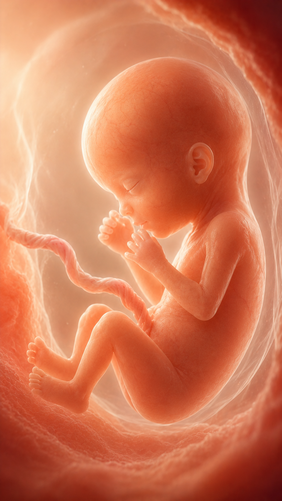
Your baby is about the size of a peach this week, roughly 74 millimeters from crown to rump and weighing somewhere around 23 grams. The head, which has been disproportionately large since the very beginning, is finally starting to grow a little more in proportion with the rest of the body. Vocal cords are beginning to form deep in the throat, even though there is no air to make sound with yet, and the face is starting to look unmistakably human on ultrasound as the eyes and ears continue migrating toward their final positions.
Under the skin, the skeleton is converting from soft cartilage into hard bone, especially in the long bones of the arms and legs and around the skull. Fingerprints are quietly forming on the fingertips. The pancreas is starting to produce insulin, the spleen is beginning to make red blood cells, and the kidneys are putting small amounts of urine into the amniotic fluid. The intestines have finished moving from the umbilical cord back into the belly, and movements are becoming more coordinated — your baby can curl their fingers and kick their legs — though they are still far too small for you to feel.
13 weeks pregnant symptoms
Week 13 is when many people first notice a real, undeniable bump, especially if this is not their first pregnancy. Your uterus is now about the size of a softball and is rising up out of your pelvis. These are the common symptoms this week:
- A small but visible bump as the uterus moves up into your lower abdomen — soft waistbands buy a little more time before maternity clothes
- Skin pigmentation changes — a darker line called the linea nigra from navel to pubic bone, and darker patches (melasma or chloasma) on the face, both driven by increased melanin and usually fading after birth
- Heartburn and constipation as progesterone keeps digestion slow; reflux gets worse if you lie down too soon after eating
- A skin glow, thicker hair, and faster-growing nails from blood volume up 30 to 50 percent
- Round ligament twinges, fuller breasts, vivid dreams, mild bloating, and a stuffy nose
- A quiet wave of nesting energy — a sudden urge to organize, plan, or start a list of names
If you find yourself feeling the opposite — flat, anxious, or unable to enjoy things you usually love — mention it at your next visit. Mental health screening is a standard part of US prenatal care, and depression and anxiety in pregnancy are common and treatable.
Taking care of yourself this week
From about now on, ACOG recommends avoiding exercises that require lying flat on your back for long stretches. As your uterus grows, lying supine can compress the large vein called the vena cava and reduce blood flow to your heart and your baby. Do core work on an incline or in a side-lying position, switch supine yoga or Pilates poses to a propped or all-fours variation, and start training yourself toward side-sleeping (left is often suggested, but either side is fine).
- Hydration is doing a lot of heavy lifting — aim for about 8 to 10 cups of water a day (2 to 2.5 liters), more on hot days or days you exercise, and sip steadily rather than gulping.
- Your daily prenatal vitamin continues, and iron-rich foods paired with vitamin C help with absorption.
- Foods to avoid: high-mercury fish, unpasteurized juices and ciders (E. coli risk), unpasteurized soft cheeses and milk, raw or undercooked meat and eggs, raw sprouts, and deli meats unless steamed until hot.
- Childbirth classes are worth a look now — hospital-based, Lamaze, Bradley method, or hypnobirthing. Most are taught in the third trimester, so popular classes book up months ahead.
This is a perfect job to share. A partner can take the lead on researching and comparing local childbirth, breastfeeding, and infant CPR classes while you rest, then you pick something together. Even just having dates on the calendar takes a little quiet weight off the months ahead.
Appointments & tests
Week 13 is often the last chance to fit in first-trimester combined screening, which typically closes around 13 weeks and 6 days. If you want it and have not had it, this is the week to call. If you have already had screening — combined first-trimester, NIPT, or both — your results may be arriving around now. Take a breath before opening anything: screenings give a individual risk estimate, not a diagnosis. A "low risk" result is reassuring but not a guarantee, and a "high risk" or "positive" screen does not mean something is wrong — it means more information might help, often through a diagnostic test like CVS or amniocentesis, or a conversation with a genetic counselor.
If you do not have a visit this week, you will be settling into the second-trimester rhythm soon — typically every 4 weeks for an uncomplicated pregnancy. At each visit your provider checks your blood pressure, weight, and urine, and listens to the baby's heartbeat. Around 15 to 22 weeks the quad screen (a blood test for neural tube defects and chromosomal conditions) is offered, and the anatomy scan is usually scheduled between 18 and 22 weeks. Come prepared with written-down questions: "Can you walk me through my screening results?" "How do I schedule the anatomy scan?" "When should I call versus go to the ER?"
Call your provider if
- Severe abdominal pain or persistent cramping that is worse than period pain
- Heavy bleeding, especially bright red and soaking through a pad — soaking a large pad in an hour or less means head in or call 911
- One-sided pelvic pain, even mild, especially with shoulder pain or dizziness
- A fever above 100.4°F, or burning, urgency, or pain with urination (possible UTI)
- A severe headache that does not ease with rest, hydration, and acetaminophen, or sudden vision changes such as spots or flashing lights
- Persistent vomiting where you cannot keep fluids down for 24 hours, or a steady leak of clear fluid from the vagina
Reflects Mayo Clinic and Cleveland Clinic first-trimester fetal-development references and MedlinePlus pregnancy guidance, 2024–2026.
Related questions
- How big is the baby at 13 weeks pregnant?
- About the size of a peach — roughly 74 millimeters from crown to rump and weighing around 23 grams. The head is finally starting to grow more in proportion with the body, vocal cords are forming, and fingerprints are appearing on the fingertips.
- Is 13 weeks the end of the first trimester?
- Week 13 is often called the last week of the first trimester, though some sources count week 14 as the first week of the second. Either way you are within a few days of the milestone, and by the end of this week the risk of miscarriage has dropped significantly compared to earlier weeks.
- When will I get my first-trimester screening results?
- If you have had combined first-trimester screening, NIPT, or both, results may arrive around now. Screenings give a individual risk estimate, not a diagnosis. A low-risk result is reassuring but not a guarantee, and a high-risk screen means more information may help, often through a diagnostic test or a genetic counselor.
- Why am I showing a bump at 13 weeks?
- Your uterus is now about the size of a softball and is rising up out of your pelvis into your lower abdomen, so a small bump may finally be visible — especially if this is not your first pregnancy. Increased blood volume, up 30 to 50 percent, also explains a skin glow, thicker hair, and faster-growing nails.
Sources & further reading
ParentFlow: one free app, pregnancy to age six
ParentFlow follows your pregnancy week by week — baby size, what's developing, your symptoms, and the appointments and warning signs that matter — then becomes a free baby tracker for feeds, sleep, and growth after birth. Free on iPhone and Android.
App Store Google Play Open Web AppThis article reflects current ACOG, Mayo Clinic, Cleveland Clinic, CDC, and FDA guidance and is for educational purposes only. It does not constitute medical advice. ParentFlow is a wellness companion — not a substitute for your obstetric provider. For any medical concern, contact your healthcare provider.